Third Text
Theresa Hak Kyung Cha and Jimmy Robert, ‘Distinguish the limit from the edge’
Paul O’Kane on this "collaborative artwork, bookwork or book", featuring writing/text by Theresa Hak Kyung Cha (1951–1982) and Jimmy Robert, published in 2025. "The result is an unusual and elusive form of collaboration between a living artist and one deceased, a form of seance perhaps, a posthumous correspondence or co-dependence."
5 October 2026
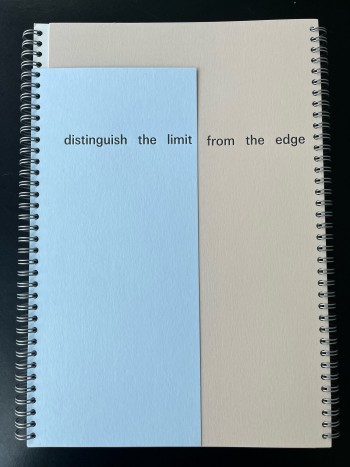
Perhaps every review of an artwork, every encounter between an artwork and those supplementary or subsequent words written in response to it, is a kind of battle, or a task at least. It can be hard and even seem impossible. It also seems that it should be difficult and that the difficulty is partly what produces value and a contribution.
We could add that the artwork’s and the artist’s role in this engagement might be to sidestep anything written about the work and which threatens to stand in for and obscure the work itself. This can leave the writer feeling as though their contribution is out in the cold.
In the case of Distinguish the limit from the edge by Theresa Hak Kyung Cha and Jimmy Robert, I must admit to feeling a certain failure, in that I may have been unable to use my own reservoir of words to bring any greater understanding, description or interpretation to the work, anything that might assist the audience.
I have previously written before, some ten years ago, about Theresa Hak Kyung Cha in an article for Third Text’s refereed journal. That piece was titled ‘Curating the Legacy of Theresa Hak Kyung Cha’. [1] Cha seemed unjustly obscure back then, but now, where I am based at least, in London, her story and reputation are better known. In the USA, she studied extensively on the West Coast, at the University of California Berkeley, and lived for a short time before being murdered in New York in 1982. If Cha is receiving new waves of attention, it might be attributable to her book Dictée (originally published in 1982) and its relevance to a current upsurge in artists’ books and in wider artists’ publishing activities. It is also, I suspect, to do with Cha’s precocious and prescient oeuvre, in which identity, technology, the body and language are brought into a unique dialogue, but one that speaks to contemporary art and artists.
My hands dance across the keyboard, shrugging off a recent writing block. I must have typed so many words in my time and yet feel a continuing outsiderliness, as someone whose contributions go unmarked and who is still hanging on to a writing career by his fingernails, despite working hard at it since the mid-1990s.
Nevertheless, once you have picked a lock and found your way around the block again you feel you can keep going, hoping that your luck, and the climate for your work, might be changing for the better; and hoping that you might be better rewarded, recognised and appreciated this time around. But while a visual artist’s oeuvre can be relatively readily appreciated, evaluated, brought to light and stored again, an art-writer’s published and unpublished works might look like nothing more than reams of demanding paper pages, various writings, disseminated in various formats. So many papers, so many pages, so many sheets.
In Hak Kyung Cha and Roberts’ collaborative artwork, bookwork or book (it’s hard to give a simple name to it), pages, sheets or leaves repeatedly become the focus of our attention. The pages are slightly taller than the generic A4 that came to dominate our lives and point to the heart of a uniform society that once aimed to become ‘paperless’. [2]

Hak Kyung Cha used what were, in her own time, new video technologies. She also used language itself as a technology, along with the operations of the body – including the tongue – in producing language.
Something that made me hesitate to write this is a recent increase in my fear of, and perhaps even distrust of, what we might call the esoteric in art. Cha was, I think, a relatively ‘esoteric’ artist; privileged, well educated, capable of digesting and utilising sophisticated intellectual and conceptual texts and ideas emerging in her time while working across a handful of languages on three continents. This enabled and encouraged her to explore language per se as a material process, as a mechanism, contrivance or contraption.
Having recently been writing about art and class, I am newly concerned about the way in which art writing that is esoteric or academic might effectively act as a gatekeeper to the possibilities of inclusivity, accessibility and participation. And yet, the minimalisitic and conceptual elements that pervade much contemporary art (probably still informed by Duchamp), remain as a late twentieth-century aesthetics of the mind, perhaps surpassing aesthetics as a pre-twentieth-century science of the senses.
Cha’s contributions are welcome and timely today: as the works of an under-appreciated woman artist; an Asian artist working in Europe and the US; a performance and event-based artist; a writer and bookmaker; and as an artful user of technologies that were contemporary to her. And all of this held together by conceptual and minimalistic influence on her as an artist of ideas and language.
When I asked my Third Text editors if they might be interested in publishing a review of this artwork, bookwork or book, they asked if I could send over some photographs, resulting in the hastily made snaps reproduced throughout this text. This showed some insight on the editors’ part, because it is true that this artwork, bookwork or book, as a very particular object, cannot simply be understood in terms of a review that concentrates on its contents.
In this artwork, bookwork or book, the form and the contents, the object, material, size, etc, are all crucial elements that need first to be described for the reader, then, or meanwhile evaluated or interpreted in some way. Having said that, attempting to describe this artwork, bookwork or book have also brought me to ask whether ‘description’ is really the best place to start with responding to any such work. Perhaps de-scribing should rather be thought of as a kind of ‘un-writing’ – as the word also suggests. [3]
The first, most obvious and most striking idiosyncrasy is that this artwork, bookwork or book has two (ring-bound) spines, making it ultimately two books that are also one, but also many, as the pages can be turned to interleave with those of another spine.
I could then say – and despite my current discomfort with the privileges of the esoteric – that this is neither just one book nor two, but perhaps an unspecified number of books. And, having said that, I could note that there are two authors, and so a certain duality pervades and plays within the whole.
The reader must pick up, handle or ‘leaf’ through this book to begin to evaluate or understand it. Thus, the requested photographs may also be of little use. Turned to a certain page the book announces its two authors, but then I need to turn the whole book over to open the pages of the Cha section titled: ‘distinguish the limit …’ This is marked by a powder blue, slightly less-than-half page that looks a little like an oversized bookmark.
Turning a page, I come to Cha’s name and the start of her own dedicated pages. These consist of scanned or photographed sheets that are almost filled with the image of a page but for generous black borders. In a short piece of typewritten text, the artist addresses the very edge of the page, and the special significance and value of that edge, by typing precariously and vertically along the extreme edge, using the words ‘THE MISSING PAGE’. These letters almost disappear into the black framing area.
So, we have pages that contain images of pages, and writing that purposefully inhabits not just the ‘margins’ of the text but the very limits of the margin. We also have the edge of the page and other factors about which the artist writes.

There follows a series of pages representing a single word, each a play on and around feuilleton – referring to a leaf, or little leaf, but also alluding to a cultural section of a newspaper. Now Cha’s words are rendered in a modern sans serif font and suspended in the centre of the page. Of course, all the references to feuilleton invoke an image of leaves, as the word invokes pages, like the leaves we are here turning in search of comprehension, meaning, value and art.
While on this demanding and complicated journey, I begin to feel charmed once again by Cha the artist and her legacy. I start to recall the special experience of encountering her work many years ago, around the time I wrote that article for Third Text, and when I first read and admired her influential book Dictée.
Dictée remains exceptional in setting before the reader what looks like a relatively ordinary, novel-length publication, only to reveal an unusual eclecticism in an exemplary artist’s book. Parts of it are literary, describing passages of experience and pieces of poetry, but also entering bravely into analytical and diagrammatic investigations of language. These reveal the influence of French theory alongside intimate dialogues aimed at an elusive maternal figure. There are elements of Korea’s tortuous political history, and words and speech are proffered as a kind of cultural environment and identity that the artist is trying to fathom using unusually heterogenous means.
Returning from Dictée to Distinguish the limit from the edge, once the feuilleton texts have passed, Cha’s voice returns in a monologue presented in a column like a poem. Reading this proves worthwhile and I note that despite my earlier statements referring to Cha as an intellectual, esoteric, formalistic, minimalistic and conceptual artist, she is also and always someone whose interactions with materials and technologies allow them to transcend their base materiality and take wing as something less worldly.
Now (and noting that this ‘now’ responds to the dramatic, performative and event-ual nature of this artwork, bookwork or book) the reader comes to pages marked with tiny grids like the maths paper I was given at school and which always seems so unwelcoming to words. They are also akin to a miniature version of the boxed pages by means of which Chinese or Korean children learn to write individual characters, one per box, rather than writing linked words and phrases along unbroken horizontal lines according to the European tradition. Fragments of typed words now appear in those tiny grids, once again, shunted up to the very edges of the paper and recalling the title of Cha’s contribution – distinguish the limit.
Surely these words at the very edge of the page or leaf are enabling us to distinguish the limit. The artist might want us to think more about this limit and distinguishing it than we glean from the obvious materials set before us. Distinguish the limit could also be advising us to become conscious of the relatively discreet or distinguished limits encountered in all that we make and do, as human beings, as artists, as thinkers, and here as analysts of Cha’s work. Perhaps I can take heed of this instruction to ‘distinguish the limit’ of my own career. What would that mean in practical terms?

Next, the pages become double-sized but crisply folded in half to precisely match the single pages that precede and follow them. They ask to be opened out by means of the double spiral binding. At the same time, they explore typed bits of words butted up against the fold; the fold that has become a central crease when opened, or the limit of an edge when folded.
Having worked our way through these permutations, we come to a contents list that prepares us for Cha’s following pages. The titles include: The Missing Page (1976), L’Image Concrete feuille and L’object Abstrait 1876.
We have arrived at a turning point in the artwork, bookwork or book, as it passes over responsibility to contemporary artist Jimmy Robert. The result is an unusual and elusive form of collaboration between a living artist and one deceased, a form of seance perhaps, a posthumous correspondence or co-dependence.
Robert’s section is titled from the edge, and now we see that we should attach this to Cha’s title in order to reveal and complete the artwork, bookwork or book’s full title: distinguish the limit / from the edge; one sentence, one title, drawn from two incomplete title elements that have finally found each other within these convoluted pages.
We head off in Robert’s direction, and strangely this is another kind of reveal – because while Cha’s pages had led us from left to right and apparently forwards, Robert’s pages lead us from right to left and, as it were, back into the book, perhaps towards its heart or origin. What we find are photographs of fragile collages or of juxtaposed images. These in turn lead us to subtle drawings, one of which seems to be a rendition of the form of a book, or perhaps a drawing of the form of a page.
Again, we are looking at pages which contain pictures of pages, engaged in a meta-textuality of an unusually concrete kind. The photographed page is a photograph of a torn page, while there is a drawing of a rectangular sheet rolled into a loose cylindrical form. There are also a drawing of a fold and an image of a scrunched ball of paper that must also once have been a sheet or leaf.
A page titled QUASI NIHIL announces a new section filled with busy typed text and with occasional lines in almost every paragraph and highlighted in blue. So, should we read these highlights and ignore the rest, or should we see them as redactions that leave us with the rest of the text to read? Things become quite dense, difficult and hard to connect, and it is not yet clear where these texts derive from.
Pushing on, we come to a bibliography headed by Maurice Blanchot and which includes other familiar and promising names such as Marguerite Duras and Yukio Mishima. There are some pages with photographs of photographed pieces of paper, more pictures pf pictures, and these work their way to a series of powder blue pages titled The picture is the text, the image is writing … These contain an interview between Robert and the book’s editor Jacob Korczynski, leading to a list of illustrations, and finally to a colophon coolly printed on plain board at the base and (perhaps) at the conclusion of the book.
The interview discusses some form of correspondence between (the living artist) Robert and (the deceased) Cha, as well as referring to influential artists and commentators, including Adrian Piper and Fred Moten. We gain some sense of empathy exchanged between these artists, dedicated, it seems, to a deconstruction or unworking (terms also used by Derrida and Blanchot) of the relationship between words, pages, papers and other materials.
Ultimately (and speaking here as an artist and writer who has recently been immersed in writing, bookmaking, designing and dissemination), this book provides us with a pleasing puzzle. It has an elusive form, one that we can never pin down or sufficiently organise. Its self-reflexivity, folds, edges and double binding invite us to endlessly turn, fold and unfold pages and thus produce changing relations between them, as well as between the two artists and their works. This is a special, if not unprecedented way to bring two artists’ works together and ‘interleave’ their ideas.

Distinguish the limit from the edge is an artwork, bookwork or book that does not belong on a shelf where its ring binding might only make it anonymous. Rather, it might lie better on a table where its solid backboard could ground it, but somehow, like a baby put down that cries to be picked up, it is always inviting us to return to it and interact, perhaps as a third artist, collaborator and animator.
Having taken the best part of a year to work through a kind of writer’s block, I recently entered into direct dialogue with this work’s makers, designers and curators, as well as with my own editors. Between them they drew attention to another aspect to this project, which took place in Participant Inc, in New York, 6 September – 3 November, 2024, curated by Jacob Korczynski.
Exploring the record of this on the institution’s website, certain esoteric and minimalistic tendencies persist, and I am faced with a series of high-quality photographs of a staged curatorial exercise. We are consequently drawn to this show’s title – flipping through pages keeping a record of time – and all of this seems to point back to the artwork, bookwork or book’s dramatic, performative and dynamic character.
Single sheets of paper lay curved or folded on the floor of an institution. Others are mounted on carefully positioned gallery walls, and some are projected by a Super 8 film (blown up to 16mm). In one or two shots, it seems that we see the artist, Jimmy Robert, passing among and between these walls and these works while the light of the projector hits his body.
Turning away from the screen I take up my ‘hard’ copy of the artwork, bookwork or book again. This follows months during which its spiral binding has looked back at me from a little bookcase on my desk. I lay it on my knee, on my lap, but it seems restless, uncomfortable, unwilling to behave as we might want or expect a book to behave. It is purposefully unwieldy, challenging the reader or respondent to use it and value it appropriately, effectively, with consideration.
This is an artwork, bookwork or book that is alive in ways that few books are; perhaps animated, or at least inspired by memories of Cha, a brave, prolific and precocious young artist taken from this world far too soon and too terribly.
The ghost of Cha is here brought back by Jimmy Robert and his editor Jacob Korczynski, as well as – and just as importantly – by the intricate design by Wolfe Hall. As a result, it becomes a milestone on the courageous road long pursued by the innovative London-based publisher, Book Works.
This artwork, bookwork or book shows how a book – though relatively affordable, modest in size, in a small edition, etc – can nevertheless expand and extend the very idea of what an artwork is, what a bookwork or book is. It sheds light on the ‘infinite conversation’ (to use a term from Blanchot) constantly taking place between artists and materials, processes and ideas, writing and its pages, leaves and binds, forms and contents, interpretations, evaluations and disseminations – all of which are referred to here in such a way as to require the book to become repeatedly unbound and rebound in the process of constantly attempting to understand and evaluate it.

Distinguish the limit from the edge (2025) is published by Book Works in association with Participant Inc, New York. Edited by Jacob Korczynski, with design and production by Wolfe Hall, it is distributed by Book Works (UK) and IDEA Books (Europe and rest of world), ISBN 978 1 912570 32 4
[1] See Paul O'Kane, ‘Curating the Legacy of Theresa Hak Kyung Cha’, Third Text 132–133, vol 29 no 1–2, January–March 2015; see also Allan Desouza, ‘The Spoken Word: Theresa Hak Kyung Cha’s Dictée’, Third Text 7:24, 1993, pp 73–79
[2] I am reminded of a poem by the New York-based art critic and poet Peter Schjeldahl, titled ‘Dear Profession of Art Writing’, in which he performatively retires from art writing, burning, in the process, a few career bridges, personal and professional connections. Schjeldahl soon returned to the critic’s yoke with the taste of humble pie in his mouth, while resuming his art critic’s career and rebuilding a few things he had ruined.
[3] Noting here that Maurice Blanchot concluded his book The Unavowable Community with references to the importance of désœuvrement, or unworking; see Maurice Blanchot, The Unavowable Community, Station Hill Press, New York, 1988, p 56.
Paul O’Kane is an artist, writer and senior lecturer at Central Saint Martins (CSM), University of the Arts London (UAL). His book, History in Contemporary Art and Culture, was published by Routledge in 2023. He has published numerous articles, essays, reviews and several artists’ self-published books with eeodo, an imprint he maintains with his partner, the artist Bada Song. Paul’s long-running seminars ‘Technologies of Romance’ and ‘A Thing of the Past?’ (on history in contemporary art) and ‘History Can I Help You?’ contextualise the impact of today's ‘new’ technologies on art, life and culture, while using history to better see and interpret our times. He is a longstanding member of AICA (International Association of Art Critics) for whom he has given several papers internationally, most recently in Romania as a keynote speaker. Paul recently turned his historical focus in the direction of class when publishing (with eeodo) Classanoia – or Falling Up – a Handbook for Class Migrants.