Third Text
It’s a Numbers Game: A conversation with Godfried Donkor
Artist Godfried Donkor, in conversation with Nicola Gray, during his solo exhibition at Firstsite in Colchester in the UK (23 May – 30 August 2026), talks about his working practices, ideas and influences.
29 September 2026
Godfried Donkor was born in Ghana but came to England as a young boy in 1973. He studied at St Martin’s School of Art in London, and Escola Massana in Barcelona, returning to the UK and completing a MA in African Art History at the University of London’s School of Oriental and African Studies (SOAS) in 1995. Centred in painting, and collage, and visual and historical research, his work encompasses subjects and influences as broad and ranging as boxing, football, Pop Art, Japanese woodcuts and Manga imagery, Christian iconographies, African history/ies, birds, popular culture(s), fashion and textiles, numbers, lotteries and number games, among others. His work has featured in the 2026 Venice Biennale main exhibition, curated by the late Koyo Kouoh. His solo exhibition ‘Godfried Donkor: It’s a Numbers Game’ was at Firstsite in Colchester in the UK from 23 May – 30 August 2026, and represented work made specifically for the exhibition as well as earlier works from almost three decades. In this conversation, which took place in the Firstsite gallery spaces on 30 July 2026, the artist talks about his work as an ongoing ‘work-in-progress’ and how the many influences and interests build on each other and coalesce, and how the specific location of the city of Colchester also fed into the exhibition. My thanks to Godfried for generously sharing his time and for his eloquence, passion and endlessly interesting reflections and comments on his own work, as well as on the context of his Colchester exhibition and the roots and trajectories of so much of his interests and working practices.

‘Godfried Donkor: It’s a Numbers Game’ exhibition wall text at Firstsite, Colchester, UK, photo by Nicola Gray
Nicola Gray: I was going to begin talking to you in relation to numbers. ‘It’s a Numbers Game’ is, after all, the title of your exhibition here at Firstsite in Colchester – what is, I think, your first solo exhibition in a non-commercial space in the UK?
Godfried Donkor: That’s right. The first in a museum-type space. I’ve had solo shows in commercial galleries, but nothing as extensive as this. It is the most thorough retrospective-style exhibition of my work so far.
NG: There are clearly numbers of import in much of the work here – and it seemed like an obvious point to begin from. But let’s get to that a little later. Instead I am going to start with ‘history’. In doing a little online research, I found this quote from you:
I think as an artist, I re-create history…. Not just black history because I don’t think black history is separate from the rest’s history. The work that I make is part of English history, is not just of black history. It is reciprocal. Histories are entwined. [1]
In the work we see here, it seems to me that there are layers and layers of history. Histories that what could be considered uncomfortable connections are often made between; histories that are very much present, if hidden and not always openly acknowledged and known about, and which have led to now. Do you find them uncomfortable? And could you say a little about how you came to work with these histories, what those histories are, or were, more specifically, and were you always interested in what has gone before?
GD: I think a lot of history can be uncomfortable. We sometimes embellish history, omit history, or forget some history deliberately because it is uncomfortable. And sometimes we exaggerate history. Even some of our recollections, stories that we tell of our childhood are enhanced sometimes to make a better story. So I have always been fascinated by history as I think you can revisit history and can remake it. As an artist, I was always looking for ways of how to make contemporary work, contemporary paintings, contemporary artworks. One of the spaces or avenues I was looking at was that I can go into history books, for example, or academic libraries. I can use academic materials and then bring them in to the contemporary world by making art about them. So a lot of the materials I was digging up, when I was at SOAS in the 1990s for example, were from archival reference books, ethnographic and anthropology books, illustrations and diagrams that were made for something else. They were made for scientists to research and talk about different elements; they weren’t made to be represented as ‘art’, or in contemporary art. So I thought, let me bring that into the contemporary art world and see if I can make new paintings from them. That was really the aim. I was not thinking about their difficult history, so to speak. Like I said, all history is related. African history is related to European history, it’s not seen outside of that context. Africa does not see itself within itself, it sees itself in the eyes of others. Other people describe Africa as ‘Africa’, or say Black is ‘Black’, that’s what I’m saying. So I find that I can use history to my own purposes really easily, and most importantly I can use it to make contemporary artworks.
NG: So would you say you were thinking along those lines back when you were an undergraduate student?
GD: During my degree courses, I was thinking about how do I make new paintings. This was in the late 1980s/early 1990s, and painting was dead, supposedly, and a lot of people were moving into installation, performance… and painters were not popular. But I wanted to carry on painting, because I had just got into it. I was learning how to paint and I was thinking ‘how do I make contemporary painting’. So the idea was to change the subject matter, to develop a subject matter that I could paint about. And this is where my early collages came from. The strangeness of these was really from an attempt to make drawings, initially, for my paintings. I thought: what if I make black and white paintings of these graphic-looking images, in a graphic style. What would they look like? That’s how the idea came about, and the aesthetics grew from that.
NG: You have spoken about how working in what you have called the ‘academic’ space, of research and writing, has informed your work as a visual artist. Did you always do that? Was it a conscious activity? I could imagine in your days as an undergraduate student at St Martin’s School of Art in London in the 1980s, that might have been a practice which if not frowned upon was maybe not given positive encouragement?
GD: No, it wasn’t. For part of my time at St Martin’s, we were left to our own endeavours. But there was a style of painting that was encouraged by the tutors because that was what they were doing. And I was not doing that, so I had to find my own way. That’s how I stumbled across this way of working, going into museums… the British Museum, for example, was a big place for me. I went to Spain and did a postgraduate painting programme there, and then came back to London as an academic postgraduate student at SOAS in African art history, with John Picton. That is what opened me up to a whole range of images that I could use, that were not being used by artists in those days, although they are now.
NG: In this room, where we are sitting, it is like there is a collage practice in action on the walls – with older work of yours side by side, or underneath or on top of, other ‘found’ images that have fed into your collages, prints or paintings over many years. It would be hard to extract and identify and talk about all the images we can see, but perhaps we could have a quick run down?
GD: Some of them go back to the earliest collages I made. What we have done here is exhibit them almost like a collage, but they start from around 1999 and go up to 2023, so there’s a wide range. Some are just text-based… and it’s been quite interesting for me to be here during this exhibition and seeing work that I made, say, in 2014, and thinking that I did want to carry on with that. And I have been doing that with some of the collages I’ve been working on in the gallery. It’s almost like bringing me back to where I was in 2014 and thinking about those things, or where I was in 2012, or 2003. There are various works that are ongoing, my work has never ended. I can come back to it any time and add something to the series. There are still works showing here that have reminded me, for example, that I want to make more football works because the 2026 World Cup has just finished. And there are the text-based works that I’ve been doing. It all keeps being added to and increasing.
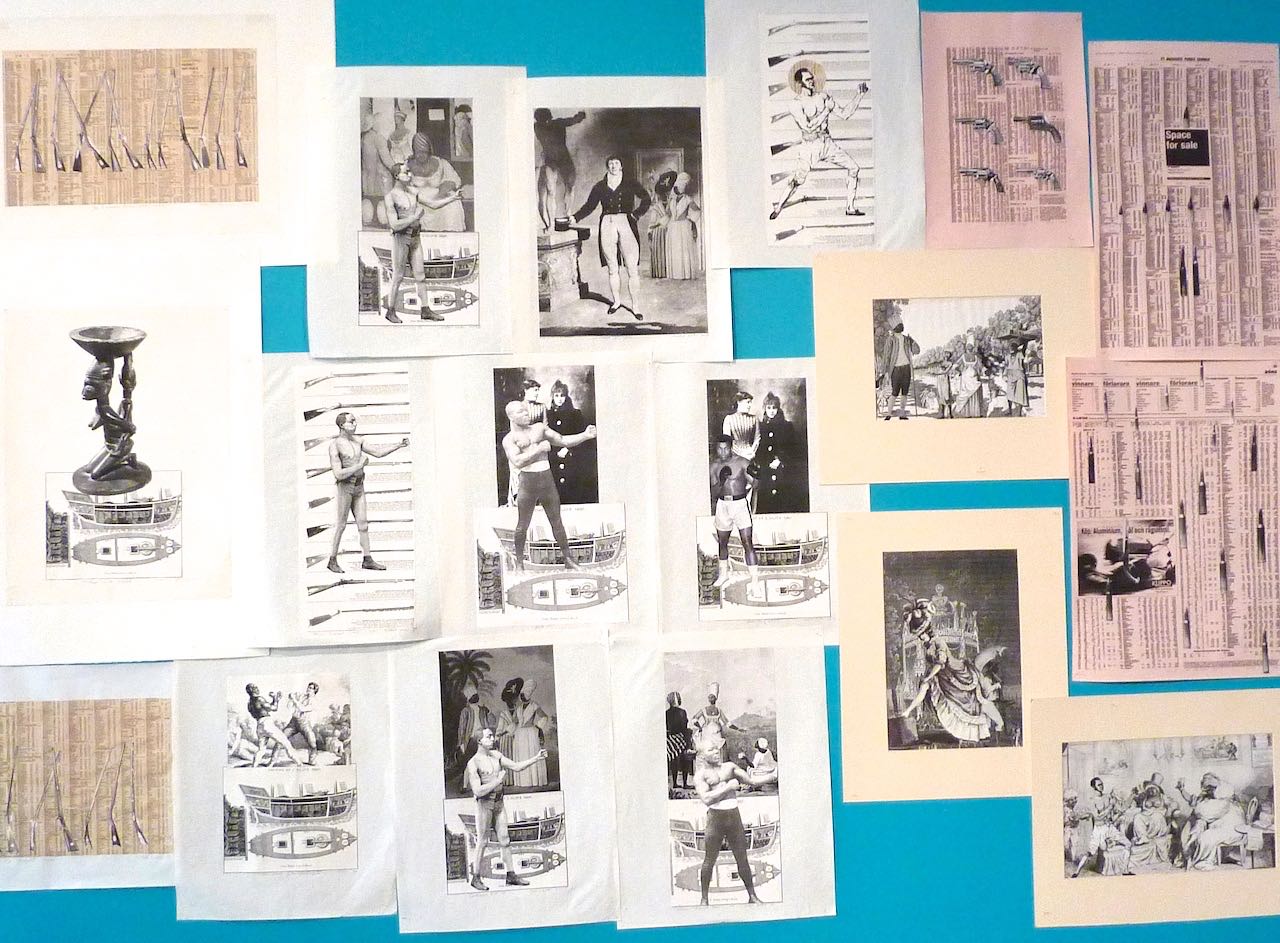
Installation view with collages by Godfried Donkor (various dates), ‘Godfried Donkor: It’s a Numbers Game’ at Firstsite, Colchester, UK, 23 May – 30 August 2026, photo by Nicola Gray
NG: More generally, what is about collage that drew you to it? It is a way of visual thinking and researching, given we were talking about that as a practice. Do you still produce ‘finished’ collages? Or is it, and was it, more a way of organising ideas and images that will lead to paintings?
GD: Initially they started out as ideas of organising images, or compositions that would lead to paintings, and then I had friends who were curators or writers who said ‘these are paintings in their own right’. So I came to look at them both as preparation for my paintings and as works in their own right. I think collages are both; they are a study, they give me a chance to play around with ideas, composition, styles, and quite quickly you can see how an image can form. Then you can decide whether to make a painting from it or not. So, yes, for me collage is very important. And they are becoming more complex in their own way, even the more simplistic-looking ones, such as the recent ones with just text.
NG: I was curious to know a little more about the collaged flags cut out of the iconic pink pages from the Financial Times, with the images of the footballers, particularly as we have just come out of six weeks of international football games on our television screens from the 2026 World Cup. I’m not sure of dates, but who are the footballers? And the flags?
GD: The footballers are dated, some from 2014, and from other years – they were done every four years during World Cups. I have been making World Cup work since 1990, when it was in Italy. I would make them every four years, although I missed out 2018 and 2022. I was busy at the time, but I was also not keen on the Russian World Cup or the Qatar one. I watched them, but I didn’t make any work. And then I decided to make some work for this latest World Cup. This is just a selection – there is more in the archives.
The flags were a project I did in 2008 as a separate project. They have just been put together in this exhibition space. All of these collages come from different periods. They have been put in some kind of chronological order here but they’re not related. The only relationship between them is one that I have made; they have been juxtapositioned. But it’s quite interesting how they are deliberately relating to each other, but only in the sense that they are sharing wall space. They’re together mainly because I made them.

Installation view with collages by Godfried Donkor (various dates), ‘Godfried Donkor: It’s a Numbers Game’ at Firstsite, Colchester, UK, 23 May – 30 August 2026, photo by Nicola Gray, courtesy of the artist and Firstsite
NG: Who are some of those footballers? I presume it is important to know!
GD: There’s Jairzinho, a very famous Brazilian footballer; and Maradona, Eusebio, and Omam-Biyik from Cameroon. When I make these footballer works, sometimes they are very famous and sometimes they are locally famous. For this year’s World Cup, I have actually been working on more local footballers than the world famous ones, meaning British, or English, players.
NG: And the flags? I recognise the Union Jack but not the others.
GD: You don’t see the colours, that’s why they’re not so obvious. There’s the Ghana flag, the China one, the flag of St George for England, the Union Jack, the Iraqi flag. I did a whole lot of them for a show I had in London called ‘State of the Union’, at T1 +2 Gallery in 2008. I selected about twenty or thirty national flags, and made them all out of Financial Times pages. I thought, ‘What happens if you take out all the national colours’, because that’s how they are usually recognised. Most countries have three colours – the UK, the US and France all have red, blue and white, while Ghana is red, gold and green with a black star – but what happens if you take out all those colours… So, it’s really talking about colour, and how nationalities identify with colour.
NG: It is also interesting to see elements of your working/thinking practice, with the wall ‘collages’ of photos and postcards, reminiscent probably of your own studio and working space.
GD: What we tried to do in this space was to recreate a sample of my studio practice. I usually have lots of reference images around, as well as older work. When I am working on a new project, I have older work that I have done previously. And then I have images that I have taken, on my travels maybe, and images of work by artists who have influenced me.
NG: There are quite a few images of Japanese works. What is about those particularly that attracts you?
GD: It’s the style of the work, the graphic style of the traditional coloured woodcuts, and more modern images. I actually have them as the background on my computer screen. I change them everyday! I use them for the colour, and the graphic painting style, as my work can be quite graphic. I also really like the Pop Art nature of them. I was really influenced by the Pop Art style of artists like Warhol in the 1980s, and Jean-Michel Basquiat and other New York artists from that time, who I was looking at when I was at art college. They look quite collagey, even though they’re paintings. So I always have references to them around, as well as to previous works that have influenced me. And there are also things that I want to remember – the birds, for example, and the Ghanaian textiles. That was for this show, as I was looking at black and white archival images, but I wanted to paint them in colour, so I needed to find colours for the colours of the fabrics I was painting.
Every studio that I have has a reference wall. There are some images of David Salle’s paintings that I saw last year in London, for example, which I thought were great. I was interested in that kind of resonance, the sense of drawing and painting coming together that is in his work.
NG: There was a gallery visitor just now asking about the image of the ibis in some collages. What interests you about the ibis?
GD: Well, the ibis is a classical bird. An African bird. And they feature way back in ancient Egyptian art. Egypt is Africa, and they are also a common East African bird. I came across them in my travels to South Africa really, and to Uganda, but they became something that I thought I could put into my work, and they become another language.

Installation view with postcards and images from the artist’s personal collection, ‘Godfried Donkor: It’s a Numbers Game’ at Firstsite, Colchester, UK, 23 May – 30 August 2026, photo by Nicola Gray, courtesy of the artist and Firstsite
NG: So let’s talk about the Boxers…
GD: The paintings of boxers here in this exhibition were for a show in 2023 called ‘Battle Royale II: The Pantheon of Champions’ at Gallery 1957 in London. I wanted to celebrate Ghana’s boxers. Ghana has had eight world champion boxers, which is actually phenomenal for a small country. Azumah Nelson is the most famous; then there is Roy Ankrah, Isaac Quartey, Joseph Agbeko, Alfred Kotei and Floyd Glutei Robertson. They go back to the late 1970s. And they all come from a region in Accra called Jamestown. That region breeds boxers, and there are more than twenty or thirty boxing gyms there. You don’t find boxers coming from anywhere else. The first ‘Battle Royale’ exhibition, in 2019 at Gallery 1957 in Accra, was about boxing in general, and I made the work actually in Ghana. For ‘Battle Royale II’, I made the paintings in Ghana but showed them in London. The works here were made in Ghana, and the reason why the walls are painted blue is that a lot of the boxing gyms in Jamestown are like that.
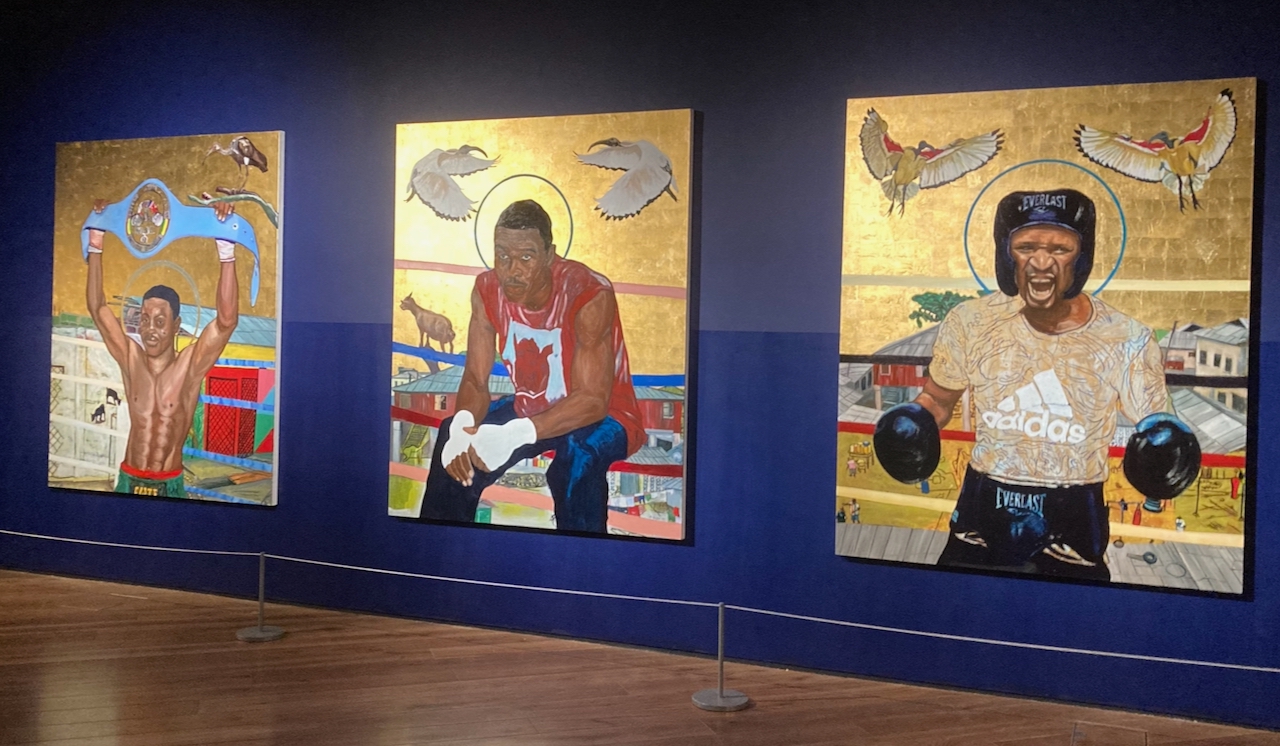
Installation view, ‘Godfried Donkor: It’s a Numbers Game’ at Firstsite, Colchester, UK, 23 May – 30 August 2026, with (left) St Alfred Kotei, 2023; (centre) St Ike Quartey, 2023; and (right) St Joseph Agbeko, 2023 (all oil, acrylic and gold leaf on canvas, 200 x 160 cm); photo by Nicola Gray, courtesy of the artist and Firstsite
NG: Why is that, do you think? Maybe to keep the aggression levels down a bit?
GD: Exactly, probably for something like that. I think it could also be for atmosphere, to maintain concentration levels. But most houses and buildings in Ghana are painted in bright colours. The aim was to recreate that here.
NG: So, in the images of boxers in the earlier collages, are we seeing the beginning of your longstanding interest in boxing and boxers?
GD: That is where it started. In the talk I gave at the gallery on 16 July, I spoke about the drawing the French painter Theodore Géricault made of a pugilistic fight in 1805 that he never saw, only heard about. A fictional image of an actual event, which I thought was really interesting – how we can fictionalise something with our imagination and that becomes the reality of an actual fact. The fight between the two boxers, Tom Molineaux and Tom Cribb, took place in London, and it was the first time a fight took place for the championship of England. The fight was so famous that Géricault made a work about it, in his own neoclassical style. It was a sketch, which was then made into an engraving, and that engraving became the image of the event, which I find incredibly fascinating. Tom Molineaux was an American bare-knuckle fighter who came to England after fighting for the British in the American War of Independence. The British had announced that after they lost the war, any slave who had fought for them would be free, so many former slaves left with the British and ended up in London. Eighteenth-century Regency London had a large population of Black people, most of whom had come from America. Two of them became famous bare-knuckle fighters, Tom Molineaux, and another man called Bill Richmond.

Godfried Donkor, The Crew II, collage, 1998, detail of installation in ‘Godfried Donkor: It’s a Numbers Game’ at Firstsite, Colchester, UK, 23 May – 30 August 2026, photo by Nicola Gray, courtesy of the artist and Firstsite
NG: The exhibition leaflet mentions that boxing is ‘both personal and symbolic’ for you. How is it personal?
GD: It’s more that it’s a sport that I enjoy because of the social connotations, and because of the arena it creates, the gladiatorial side of it. Sport is an interesting way into characters and stories that one can tell.
NG: The paintings of boxers in the room with the dark blue walls (and a soundtrack) have gold-painted backgrounds or haloes around the figures’ heads, as in early Christian iconography. Did such images, and/or Christianity itself, have a particularly important role in your childhood? Or does it stem maybe from looking at examples of paintings in European art history?
GD: It’s the latter, really. As I said, I was looking for a language with which to make new paintings when I left art school, and icons were one of the ways in. So I started making paintings of people that I liked, people who were famous, as icons. I used the halo quite a lot. In some of these early works, there are images of, for example, the Three Graces and a mother and child with haloes; the footballers have haloes. There’s a ‘Madonna’ series of images of women, who all have haloes – they are my madonnas… I was really using this iconic language from religious images, for example, to compose new ways of painting. When I say ‘new’, we kept hearing that painting was dead, so one had to find a new way of making paintings. For me, this was the subject matter, and I was finding new subject matter to paint about. It was the things people weren’t painting about that I was interested in. Yet, it is actually quite contemporary because Pop Art is about that too – it’s a graphic iconography, as in Warhol’s images. I was looking at ways of producing contemporary work and using an older language to do so.

Godfried Donkor, Our Madonna and Child, 2014, oil and collage on paper, 80.5 x 60 cm (framed), courtesy of the artist and Gallery 1957
NG: So, let’s turn to the series of works with the heraldic images embroidered onto either actual pages from the Financial Times, or your ‘doctored’ and reprinted ones. They represent over ten years of your engagement with them, from about 2008 to the present. Can you tell us how you came to these heraldic images?
GD: They came about almost by accident. I was doing a project in Ghana with a series of costumes for a performance called Jamestown Masquerade in 2017, and I collaborated with a fashion designer for that. The idea came to me that I had these heraldic images, in black and white, in one of my archival sources of materials. I had found them in a book in a chapter about European families who had Africans in their coats of arms, curiously enough... all from the Middle Ages, the 1300s and 1400s. No-one knew how or why this came about. I had collected them as a source and I really wanted to make some work about them, but I didn’t just want to draw them. I had started to paint them on Financial Times pages, in colour, but I hadn’t ever shown them. But after I met the fashion designer in Ghana, I thought maybe we could embroider them. I gave the embroiderers some drawings, and it took a year or so of going backwards and forwards to produce something. That’s how they began. They really began as an experiment, and each time I went to Ghana we made more, in groups of ten or twenty. Each time we show them in a gallery, sometimes they sell and we run out!

Godfried Donkor, Financial Times dreams coat of arms VIII, 2015, mixed media embroidery on paper, 65 x 42 x 4 cms (framed), courtesy of the artist and Gallery 1957
NG: But the doctoring you have done on some of those pages is not always immediately obvious. You have done that very subtly…
GD: That is another feature of work that I have been doing since 2007, where I have been digitally doctoring pages from the FT. This is another work in itself, where I have taken out columns with company data of shares and stocks, and have put in my own data – say, for example, from the numbers games where people play the Lotto where they interpret their dreams with numbers and they go and play that number. Sometimes I use African proverbs, which are often about money – for example, a rich man always has friends, a poor man doesn’t, as when you’re rich you have a lot of people around you, but if you’re poor no-one wants to talk to you.
NG: You also have alphabetical lists, like the lists of famous people, the musicians, the singers, which are obvious, but there are also lists, like a dictionary, of things, like ‘automobile’ or ‘cockroach’, ‘crab’ or ‘drum’.
GD: Those are things that you dream about, and you play the numbers. Another word for the ‘numbers game’ was also a lottery scheme in African American communities that is called ‘playing the numbers’. Most people in such communities, especially in the 1950s and 1960s, up to the 1980s or ’90s, and some older people probably still do, would interpret their dreams, or have someone interpret their dreams for them – and they would play three numbers based on that.
NG: Do you think that is something that originally came out of West Africa, say, with the transporting of people across the Middle Passage?
GD: It probably came from the Chinese, who built the railroads in America. It’s a three number lottery. Here in the UK we play six numbers in the National Lottery, but most lotteries are three numbers. There are all kinds of reasons for that, with three being a magic number. Apparently the African American communities mixed their folklore with Chinese folklore.
NG: And do they do this in Ghana that you know of, or something similar?
GD: No, they don’t play the lottery with dreams, as far as I know. They play a lottery with numbers, but I’m not sure how it works. Everywhere in the world has form of a numbers lottery.
NG: So could you say a little more about the lists of words, and the proverbs and the names of singers and musicians, and what they might represent, and how you came to bring those things together because they don’t immediately seem to be related.
GD: Well, they’re not actually. Again, accidentally putting them together makes them related. If you put different elements that are not related on the same sheet, they become related…
NG: And especially when it’s pink!
GD: Exactly! In the original FT columns, all these companies are not necessarily related but the share prices on that day, whether they’re going up or down, make them related. So I was trying to do the same thing really, to follow that pattern of actually assembling non-related things or elements or items on the same sheet of paper, in the same column, and making them relatable.
NG: And the embroidered heraldic images on top of them are another element as well.
GD: That makes them stand out. I discovered very early on in my practice, which you can see from 2001, or whenever, that anything that you put on top of the FT is magnified and enhanced. So I can put anything on top of the FT and it will look complicated and thought out, when it isn’t necessarily that at all!
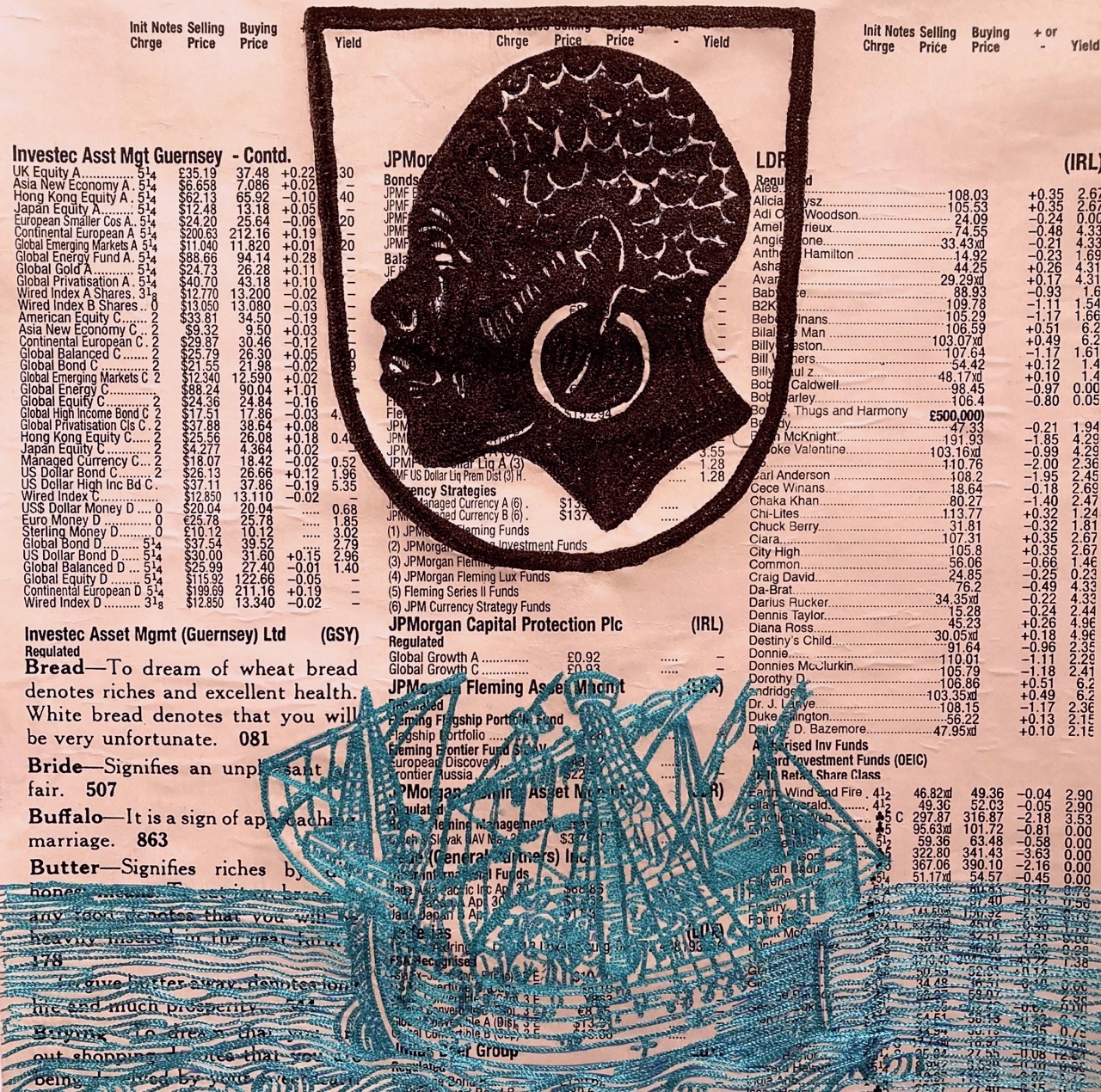
Godfried Donkor, Parts beyond the seas (detail), 2025, embroidery on digitally collaged Financial Times paper, courtesy of the artist and Gallery 1957
NG: I heard a lady ask you a few days ago when I was in the gallery about what the significance of using the FT pages was for you, as the immediate assumption is that it would be to do with global capitalism and money markets, and all that – and there is something in that…
GD: There is something in that, and in all of us, but there is also something quite personal because we are all financially obsessed in our own lives, aren’t we…
NG: Because we have to be! We need money.
GD: And why do we need money… because the world is run by money. So that is one of the bases that I started from: why are we always obsessed with figures and numbers and money. Because money runs our lives. Numbers run our lives. I don’t understand it, but if I can create a visual art form from that, then that’s exactly what I want to do.
NG: You’ve said that numbers do have a deep fascination for you. Can you trace that to any particular things that you might have done, or were perhaps introduced to as a child?
GD: No, not really. I am not into numbers as a numerologist. My fascination with numbers is not scientific in any way. I don’t input my birthdate numbers into things, or anything like that. It’s much more general. It’s the unknown things, the combinations of things, how we all think about numbers every day, from the moment we wake up: the time we wake up, the time we go to bed, the time we eat, the times we do things, when we meet friends, or whatever. Whatever we do, there are numbers behind it – which we don’t always acknowledge, or consciously think about. Numbers are part of everything we do. Computers and mechanics operate through numbers, so I look at it like that, in a more general way.
NG: It can be a common conception that artists are not good with numbers. Or words. Or even interested in them…
GD: I certainly wasn’t very good with numbers. But I look at numbers differently now. When I’m painting, for example, I think about the numbers of layers of paint I am putting on; how many layers of gesso or primer to put on before I start painting; how many of layers of blue paint to get that great blue. So I look at numbers now in a totally different way than I used to.
NG: Going back to this specific exhibition, you have been able to present your work, particularly in this space where we are sitting, with the earlier collage works, and the postcards, etc, almost like an ongoing work-in-progress. Is that a fair observation?
GD: Yes, I think it is. That is actually quite interesting because I think all of my work is an ongoing work-in-progress. It’s open-ended. I don’t finish one series of work, and then move on to another series. It’s all meshed together, and it carries on. I revisit work. For example, I can revisit things that I haven’t worked on for a while and reproduce it. The large, six-panel piece on the wall at the entrance to the exhibition, with the cut-outs of African figure carvings – that was literally done in May this year for this show, but the genesis of it was the figures over there, the mother and child collage. So everything is always going back, or coming forward. So, yes, it is always a work-in-progress.
NG: There aren’t any of the usual wall texts and labels here that we get used to seeing in exhibition spaces. There are some dates on individual works going back to the 1990s, but other than that nothing is dated, which renders everything almost with a timeless quality.
GD: That’s interesting, because that is more the gallery’s choice than mine. I wouldn’t normally do that.
NG: So it’s had an after-effect that you didn’t predict or think about, as it were.
GD: Yes, it has. I didn’t really think about it that way until it was done. The same thing happened with using colour on the walls, which was done to reflect the painted walls in Ghana. But it has actually really enhanced the work as well. A lot of the colours I use in my work are relatable to colours that I see in Ghana.

Installation view, ‘Godfried Donkor: It’s a Numbers Game’ at Firstsite, Colchester, UK, 23 May – 30 August 2026, photo courtesy of the artist and Firstsite
NG: And there are also the very subtle elements of sound, which makes the whole exhibition almost like an installation.
GD: It does. The British explorer Thomas Bowdich, who went to Ghana (we will take about him later) wrote these musical notes in 1817 – he called them ‘airs’, musical ‘airs’ – and I had a classical musician interpret them with a cello, so that is what is playing in one room. And in the room with the boxer paintings, there is the sound of the boxers punching boxing bags, which was recorded in one of the Jamestown boxing gyms. Both recordings were made in Accra, for this show.
NG: The boxing sounds are not what one might think of as the sounds of boxers boxing. It’s actually very quiet, and lends a very evocative atmosphere.
GD: Yes, it is, and you can hear the breathing. There were a number of sounds in the recordings – of skipping, and the coaches shouting – but we chose the sound of the bags being punched.
NG: Have you used sound previously like this?
GD: No, not like this. I’ve worked with sound in video work, but this is the first time I have used sound in its own way like this. And there will be more to come!
NG: But you are essentially a painter, and for whom painting is a central activity.
GD: Absolutely, yes. All the other stuff that I do is to give me material to make paintings. But sometimes it gets lost!
NG: Is painting, perhaps, just one way among others of pulling together images, albeit the primary one?
GD: Yes, everything else is really to support the paintings. My most recent paintings are on show here, and were made especially for this exhibition, with the Bowdich theme in mind. My connection with Colchester, and Firstsite, came through finding out about Sarah Bowdich, who went to Ghana in 1817 with her husband, Thomas Bowdich, who I had done a project about already, in 2017.


Godfried Donkor, left: Warrior Twins, 2026, oil on canvas, 150 x 100 cm; right: Tribe/Scar/Man, 2026, oil on panel, 35 x 30 cm, courtesy of the artist and Gallery 1957
NG: Perhaps you can tell us about Sarah and Thomas in a moment, but I’d like to ask you about Colchester first. Slightly unusually, perhaps, for an exhibition in a contemporary art space, there are several elements in your work here that relate specifically to Colchester, the site of Roman Britain’s original first capital, Camulodunum (before they moved it to Londinium), and Britain’s ‘first city’ as it has taken to calling itself. You make a connection, for example, between Boudicca (the Iceni queen who sacked the Roman town in the rebellion she led against the Roman occupiers circa CE60) and Yaa Asantewaa, the leader of the Ashanti War of the Golden Stool, in around 1888. How much research did you do into Colchester’s history, or did things just come up?
GD: When I was initially approached by Firstsite about two years ago, I did start to look for connections. Sometimes I might think about making site-specific work, for example, and I did do some initial research into Boudicca – and made an immediate connection with the Ashanti warrior queen, Yaa Asantewaa, who mobilised a section of the Ashanti army against the British, like Boudicca did against the Romans. And I also mentioned to the Firstsite team the project that I had done in Ghana in 2017, Jamestown Masquerade. This looked at the time Thomas Bowdich had spent in Ghana, which I had originally learnt about during my MA at SOAS. That is when I came across Thomas Bowdich’s book, Mission from Cape Coast Castle to Ashantee, &tc in the British Museum (published in 1819, and on display in this exhibition) about his time in Ghana. Jamestown Masquerade came to the attention of the British Museum, and it was mentioned to me that Thomas had travelled to Ghana with his wife, Sarah, and that it was thought it was actually Sarah who had been the artist for the illustrations in the book. In the initial talks for this Firstsite exhibition, we looked Sarah up and discovered that, coincidentally, she actually came from Colchester. So once I knew that, that made two links, which became an anchor for this show and that I could build the exhibition around. So everything became relevant, the collages, the boxing work – all the work I had done became relevant, because it was all part of the process that made these paintings.
NG: Tell us a little more about Thomas Bowdich, and Sarah.
GD: Thomas Bowdich was an English explorer commissioned by the British government to go to the region, to find out more about the ‘Ashantees’. They were well known as gold traders as well as a military force, and the British wanted to find out what, as opponents, they needed to know and how they could deal with them. His book really produced the so-called ‘scramble’ for that part of the world, as he was the first person to come out and say that there was lots of gold there. At the time, I was quite obsessed by the watercolour it was presumed that he had done of the magnificent Yam Ceremony, which is in the book and that he signed with his own name. It was only later, once I had made the work in 2017 that the British Museum started talking to me about Sarah Bowdich, about her being an artist in her own right, and that she accompanied her husband to the Gold Coast in 1817. And that she was maybe responsible for the paintings. That changed everything. So now, it was for me to really concentrate on Sarah Bowdich, rather than Thomas, and this show finishes with a space all about paintings relatable to Sarah Bowdich.
NG: A serendipitous discovery! Unlike most exhibitions in other contemporary spaces, whether in central locations in London, or elsewhere, you have been coming out to Colchester from London (about an hour’s train ride away) to spend two days a week actually being in the exhibition space, working on collages, or whatever. So you’ve been here for any visitor to speak with and ask questions, and there have frequently been lots of children around doing workshops during the school holidays. The Firstsite galleries are quite open and not like the usual white cube spaces, and public accessibility and involvement is a necessary remit for art spaces, and rightly so, but is often paid lip service to with maybe an artist’s or curator’s talk. You did do a public conversation, with Ekow Eshun, but being present in the space for a significant amount of time, and engaging with your work in the exhibition and making some work in the space itself is different. How has that experience been and have you had some interesting interactions?
GD: Yes, it has been really important. Often with a solo exhibition, say, you don’t often get a chance to sit in the space with your work, so that has been really interesting, almost revolutionary even. I’m revisiting every single piece. The thing that I have in common with every work here is that I made them, and at the time I was making them I was thinking about loads of things that I wanted to do, but didn’t get to do. But now, with revisiting them, going right back to 1998 or so, I remember thinking that I wanted to do some more like that at the time. So I have actually been making some new work, and looking at previous work, as well as engaging with all the people who have walked through and looked at my work and perhaps asked me about something. It has changed my practice in a way.
NG: I wanted to close just by asking you something about Third Text, as this will be published in the journal’s open-access, Online journal on our own website. You did have some previous association with Third Text in the earlier years when Rasheed Araeen and Jean Fisher were editing the journal. There was a review of your own work at Gallery 198 in Brixton, [2] and you contributed a piece of writing yourself, in 1996, a review of the work of Faisal Abdu’Allah and Clive Allen. You actually say something very pertinent to what we have talked about today in that review, albeit in the context of writing about other artist’s work, that I would just like to quote again here:
As image makers, both artists recognise that the power to create images is linked to one’s ability to direct and adapt one’s future. But image makers or not, we all realise that our future is made up from the past and the present. [3]
Could you say something about that association with Third Text – how it came about, and what it meant for you at that time? Is it still of import for you, and do you still read and follow Third Text?
GD: I admit that I have lost track of it somewhat recently, particularly after it went onto a more digital, subscription platform. But my association with the journal really began with Jean Fisher. She used to come to all our shows when we were all starting out as younger and up and coming artists. Third Text was a very important publication, that’s where we looked to for the more intellectual conversations about art, and about art that wasn’t necessarily in the mainstream of British art. It was very international, and Rasheed Aareen was a well-known artist in his own right. But it was really Jean who drew me to Third Text as she would come out to our shows, and she was very influential with her encouragement and support.
NG: She was always very good at doing that, for sure. Thank you so much, Godfried, for your time today, it has been a pleasure.
[1] See ‘Godfried Donkor: A painter who happens to make collages’, the artist in conversation with Raquel Villar-Pérez, Africanah.org, 5 September 2018
[2] See Frederica Brooks, ‘Gods and Demi-Gods’: Godfried Donkor, Third Text 8(26), 1994, pp 97–98
[3] See Godfried Donkor, ‘Revelations: Faisal Abdu’Allah and Clive Allen’, Third Text 10(35), 1996, pp 98–101
Nicola Gray is an artist, writer and editor, and currently Website Manager at Third Text. Her writing has appeared in Third Text, Hyperallergic and Tribe photo magazine, among other places. She first began working with Third Text in 1993.